School Patron – Saint Joseph
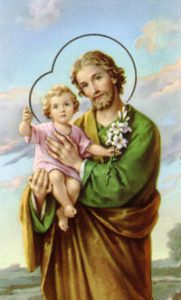
St. Joseph is the patron saint of our school, and a role model in all that we do. In learning about his life and the mission entrusted to him we are able to grow in faith and love together. St. Joseph is shown to be the perfect model of Christianity through his purity of heart, patience, and fortitude.
Just like us, Joseph understood the importance of work. He was a carpenter—a builder—and probably taught Jesus his trade. Through his work, Joseph honoured the Father in heaven and continued the act of creation. He lived in dignity and was known to be a ‘just man’.
What we know about the life of Saint Joseph is contained in the gospels of Saint Matthew and Saint Luke. As the Bible tells us, he was chosen among all men to be the husband and protector of the Mother of Jesus Christ. To his loving care, the childhood and youth of the Redeemer of the world was entrusted and it is to his loving care that we entrust our school community:
St. Joseph,
Guardian of the Holy Family
and patron of our school,
teach us to love Jesus and Mary.
Teach us to see Jesus in others
and to be like you:
loving, patient,
caring, hardworking
and reliable.
Help us to live a life for God,
day by day in faith and trust.
Amen.
House Saints
Saint Bede
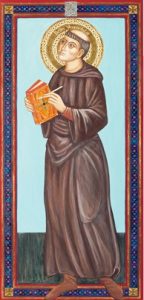
St. Bede (673 – 735) was a monk and early historian of the Catholic Church in England. At the age of seven he was entrusted to the care of Benedict Bishop to be educated. After his schooling, Bede moved to the monastery of St Paul at Jarrow, where he spent the rest of his life. Bede died in the monastery in May 735 AD.
Bede spent his whole life writing and is widely regarded as the greatest of the Anglo-Saxon scholars. He wrote over 40 books about theology and history. His most famous work, which is an important source for the understanding of early British history and Christianity is ‘The Ecclesiastical History of the English People’ which was completed in 731 AD. It is the first work of history that uses the dating system AD.
St. Bede is the Patron Saint of scholars and historians.
Saint Hilda
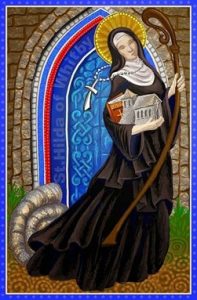 St. Hilda of Whitby (614 -680), was born into the Royal house of Northumbria. She was the founding abbess of Whitby Abbey which became one of the most influential religious centres for education in the country. Under her guidance many of the great names of the early church were established. St. Hilda died in Whitby on the 17th November 680 AD.
Hilda devoted her life to teaching and became known for her great wisdom – kings and princes consulted her on all manner of things. She was often described as a mother figure and it was said that she was kind to all that she met and protected her community. Local people believe that St. Hilda saved Whitby from a plague of snakes by turning them to stone and she is often depicted standing upon serpents in carvings and pictures.
St. Hilda is the Patron Saint of learning and culture.
Saint Aidan
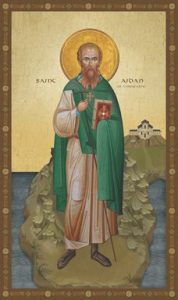 St. Aidan of Lindisfarne (approx. 590 – 651), was an Irish monk who restored Christianity to Northumberland. Aidan would walk from village to village speaking to people about their lives and Christianity. It was through this approach that he slowly restored people’s faith and was able to establish a monastery on the island of Lindisfarne.
Aidan spent many years as bishop and was responsible for the construction of numerous churches, monasteries and schools throughout the north east – he worked tirelessly in aid of the poor. St. Aidan was also responsible for saving Bamburgh and its royal house from destruction after invaders attempted to set the town ablaze: his prayers for help saved both the buildings and townspeople.
St Aidan is known as the Apostle of Northumbria and Patron saint of firefighters.
Saint Cuthbert
 St. Cuthbert (approx. 634 – 687) was convinced to enter Holy Orders at Melrose after receiving a vision of a soul being carried to heaven by angels. The next day he learned of the death of St. Aidan, the first Bishop of Lindisfarne, and this convinced him of his calling. Unfortunately, Melrose Abbey was struck by the plague which killed many of its members. Cuthbert survived and continued his work as a missionary whilst also aiding plague victims.
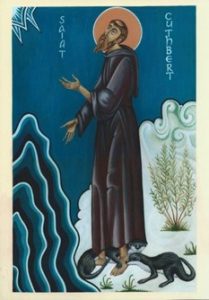
Cuthbert was one of the most important mediaeval saints of Northern England. He was well-known as a travelling priest spreading the Christian message to remote villages and travelling vast distances across the country to ensure that the message was heard. St. Cuthbert had a reputation for healing and reportedly performed several miracles during his lifetime. During times of prayer and reflection, Cuthbert was known to stand waist-deep in the North Sea to calm his mind. Otters were said to have been drawn to him and would warm his feet after the coldness of the waters.
St. Cuthbert is the Patron Saint of Northumbria and otters.